
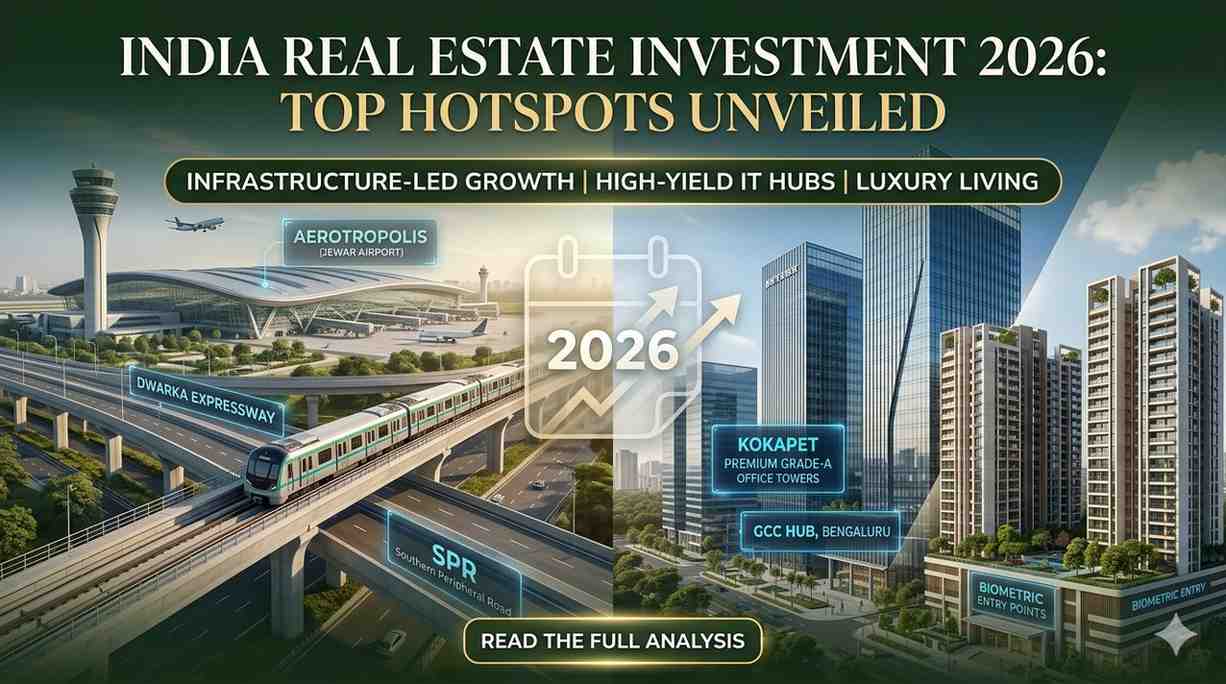

Top 5 Indian Real Estate Investment Hotspots
The Indian real estate landscape in 2026 is no longer about speculative “flipping” or chasing random urban expansion. We have entered an era of Infrastructure-First Growth. Today, the most successful investors aren’t just buying land; they are buying into connectivity corridors, global capability centers (GCCs), and “Aerotropolis” ecosystems.
With the 2026 market being driven by a surge in luxury residential demand and a massive influx of NRI (Non-Resident Indian) capital, choosing the right micro-market is critical. Below is a deep dive into the top 5 investment hotspots that are defining the real estate story this year.
1. Gurgaon (Gurugram): The Power of the Triple Corridor
Gurgaon remains the undisputed crown jewel of North Indian real estate. In 2026, the city’s growth is concentrated in what experts call the “Triple Corridor Effect”—the synergy between the Dwarka Expressway, the Southern Peripheral Road (SPR), and the Global City project.
The Dwarka Expressway Advantage
Now fully operational, the Dwarka Expressway has slashed travel time to IGI Airport to under 20 minutes for residents in Sectors 102 to 113. This is no longer a future promise; it is a functional reality.
- Investment Insight: Focus on “Shop-cum-Office” (SCO) plots. These assets are delivering rental yields of 8–10%, far outperforming traditional residential yields.
- Luxury Shift: There is a distinct “flight to quality,” with senior professionals seeking high-end gated communities that offer 4BHK+ configurations and concierge services.
The SPR & Global City Hub
The Southern Peripheral Road has become the “growth spine,” connecting Golf Course Extension Road to NH-48. Adjacent to this lies the 1,000-acre Global City, a futuristic CBD (Central Business District) expected to house the next wave of Fortune 500 headquarters.
2. Hyderabad: The Balanced Powerhouse
If Gurgaon is about high-octane luxury, Hyderabad is about sustainable balance. In 2026, Hyderabad has solidified its position as the most affordable major tech hub in India, attracting thousands of professionals from costlier cities like Mumbai and Bengaluru.
The Western Expansion (Kokapet & Tellapur)
The Financial District has expanded its borders, making Kokapet and Tellapur the primary targets for long-term investors.
- Growth Metrics: Property prices in Kokapet have touched roughly ₹9,000 per sq. ft., backed by the Golden Mile Business District.
- Infrastructure Lead: The Metro Phase II expansion (expected to fully integrate by 2027-28) is already driving a pre-emptive appreciation of 8–12% in connected micro-markets.
3. Noida: The “Aerotropolis” Era
Noida and the Yamuna Expressway belt are witnessing their most defining chapter in 2026. The Noida International Airport (Jewar) is now on the verge of full operational capacity, transforming the region into a global “Aerotropolis.”
Yamuna Expressway: From Speculation to Utility
For years, this stretch was seen as a long-term gamble. In 2026, the narrative has shifted to real utility.
- Industrial Magnet: With over 40,000 acres earmarked for industrial and logistics development, the demand for mid-segment housing near Sector 18 and 22D is skyrocketing.
- Commercial Spark: The proposed Aerocity near the airport is drawing hotel chains and MICE (Meetings, Incentives, Conferences, and Exhibitions) centers, creating a massive rental pool for studio apartments and commercial retail.
4. Bengaluru: The Resilience of the Silicon Valley
Despite infrastructure challenges, Bengaluru remains the safest bet for rental-focused investments. The city continues to capture nearly 40% of India’s new Global Capability Centers (GCCs), ensuring a steady pipeline of high-income tenants.
North Bengaluru (Devanahalli)
The focus has shifted toward the North, specifically the Devanahalli corridor.
- Why it Works: Proximity to the airport and the development of the Aero IT Park have turned this into a “Work-Live-Play” destination.
- Biophilic Design: A major trend in 2026 is the demand for “Green-Edge” locations. Investors are prioritizing projects that offer forest-inspired landscapes and sustainable water management systems.
Whitefield’s Luxury Evolution
Whitefield is no longer just a tech suburb; it has evolved into a luxury residential hub. Integrated developments that combine office spaces with premium retail and high-end apartments are seeing the highest capital appreciation.
5. Pune: The Integrated Township Model
Pune has successfully transitioned from a satellite city to a standalone real estate giant. Its strength lies in its dual-economy of IT and Manufacturing.
Hinjewadi & Baner Corridors
Hinjewadi continues to be a powerhouse, with rental demand increasing by over 18% in the last year alone.
- Township Focus: Investors are favoring Integrated Townships that provide a self-sustaining ecosystem—schools, hospitals, and offices all within a 15-minute radius.
- Connectivity: The Pune-Mumbai Expressway proximity remains a key driver for Western Pune, attracting investors from Mumbai who find Pune’s “lifestyle-per-rupee” value significantly higher.
Summary Table: 2026 Investment Outlook
| City | Primary Growth Driver | Targeted Micro-Market | Expected Capital Appreciation |
| Gurgaon | Infrastructure (Dwarka Exp / SPR) | Global City / Dwarka Exp. | 12% – 18% |
| Hyderabad | IT Expansion & Metro Phase II | Kokapet / Tellapur | 10% – 15% |
| Noida | Jewar Airport / Logistics | Yamuna Expressway | 15% – 20% |
| Bengaluru | GCC Growth / Tech Hubs | Devanahalli / Whitefield | 8% – 12% |
| Pune | Integrated Townships / IT | Hinjewadi / Baner | 9% – 13% |
The Bottom Line for 2026
Real estate investment in 2026 is characterized by a “Flight to Quality.” Whether you are looking at the luxury high-rises of Gurgaon or the tech-centric corridors of Hyderabad, the most important factors are:
- RERA Compliance: Non-negotiable for safety.
- Infrastructure Proximity: Specifically Metro access and Airport connectivity.
- ESG Integration: Properties with green certifications are commanding a 5–10% premium in both resale and rental markets.
As we move deeper into 2026, the window for entry-level prices in these hotspots is closing fast. For the savvy investor, the time to act on these infrastructure-led opportunities is now